

The HZS series stationary concrete batching plants are a mainstream procurement category in the global engineering construction and commercial concrete market. The stationary concrete batching plant prices are not uniform but vary depending on capacity level, configuration standards, and customization requirements. Based on FOB prices from major construction machinery manufacturers in 2026, the basic price range for the entire HZS series (models 25-240) covers US$20,000 to US$240,000, with different configuration combinations resulting in price fluctuations of 15% to 30%.
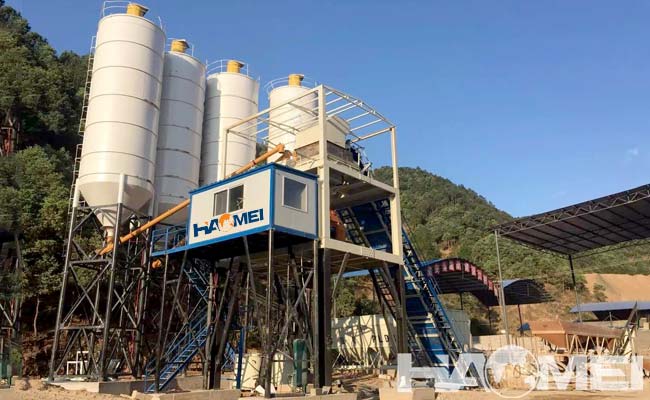
From a capacity perspective, the HZS series stationary concrete batching plants can be divided into three clear price tiers, corresponding to different application scenarios and investment scales.
The small-capacity tier covers HZS25 to HZS50 stationary concrete batching plant, primarily targeting lightweight temporary projects and rural infrastructure, with a basic standard configuration FOB price of US$20,000 to US$60,000. The HZS25 stationary concrete batching plant is equipped with a JS500 mixer, two 50t cement silos, a three-compartment aggregate batching machine, and a basic electrical control system, with an FOB price of US$20,000 to US$35,000; the HZS35 stationary concrete batching plant is equipped with a JS750 mixer, priced at US$32,000 to US$48,000; and the HZS50 stationary concrete batching plant is equipped with a JS1000 mixer and two 100t cement silos, priced at US$45,000 to US$60,000. This series of equipment offers low investment thresholds and flexible deployment, making it a cost-effective choice for small projects.
The medium-capacity series stationary concrete batching plant covers HZS60 to HZS120 and is the main choice for county-level commercial concrete plants and medium-sized infrastructure projects, with a basic FOB price of US$65,000 to US$175,000. The HZS60 stationary concrete batching plant, equipped with a JS1500 main mixer, is priced between US$65,000 and US$85,000. The HZS90 stationary concrete batching plant, a general-purpose model for engineering applications, features a JS2000 main mixer and three 100-ton cement silos, priced between US$105,000 and US$135,000. The HZS120 stationary concrete batching plant, a benchmark model for medium-sized commercial concrete plants, optimizes batching and unloading cycle efficiency, priced between US$130,000 and US$175,000, and can support stable continuous operation for 8 hours per shift.
A large-capacity lineup, ranging from HZS180 to HZS240 stationary concrete batching plant, serves the core urban commercial concrete market and large-scale national infrastructure projects, with a basic FOB price of US$140,000 to US$240,000. The HZS180 stationary concrete batching plant is currently the mainstream benchmark in the global commercial market, equipped with a JS3000 main mixer and four 1000t cement silos, with a basic FOB price of US$140,000 to US$185,000. The HZS240 stationary concrete batching plant, equipped with a JS4000 large-capacity mixer, is suitable for ultra-large-scale linear engineering supply needs, priced at US$210,000 to US$240,000.
Configuration upgrades are the core variable affecting the final price and the main source of price fluctuations. The basic stationary concrete batching plant price usually only includes the standard configuration; in actual procurement, premiums often arise due to upgrade requirements. Regarding the expansion and addition of powder silos, each additional 100t standard cement silo increases the total equipment price by 8% to 12%; replacing it with a 200t large-capacity silo can increase the premium by 15% to 20%. Regarding environmental system upgrades, the basic model only comes with a silo top dust collector; upgrading to a fully enclosed material shed, pulse bag dust collector, sand and gravel separation, and waste slurry recovery system increases the total price by 15% to 25%, meeting the environmental emission standards of most countries. Regarding control system and main unit upgrades, upgrading from a basic PLC touch control system to an intelligent central control system with remote monitoring, production data traceability, and ERP integration increases the price by 10% to 18%. Upgrading the mixing main unit from a domestic standard model to an international brand main unit can result in a 20% to 30% premium, significantly improving the lifespan of wear-resistant parts and the uniformity of mixing.
For purchasers, it is not advisable to base decisions solely on the initial purchase price. For temporary projects with a duration of 1-2 years, the basic standard model is sufficient. For commercial concrete mixing plants with an operating cycle of 5 years or more, it is recommended to prioritize upgrading to environmentally friendly and wear-resistant components. Although the initial investment increases by about 20%, it can reduce compliance risks and later maintenance costs, resulting in better returns over the entire life cycle.
About Us
| News
| Products
| Download
| Contact Us
Our job is much more than being construction equipment-concrete batching plant manufacturers,We are responsible to all the people who are concerned with this road and building construction industry and we strive to provide the best quality, price and services.
Address: No.14 Waihuan Road, New district, Zhengzhou, China.


